

If the title makes you bristle, it’s probably because you thought taste was the one human quality that can’t be replicated by AI. I thought so too, because it was comforting. But as a designer, this is an existential question — one I knew I had to take the time to understand properly. I learnt that taste won’t save us. But judgement will.
Taste is Learnt
As anyone who’s been to design or art school will tell you, the first thing you do is learn about the works of other artists and designers. In my Art History 101 class — one of the subjects I loved the most — I had an amazing textbook that exposed me to countless works of art across history. Among many other things, I learnt the patterns that we find beautiful, understood the nuances of composition and how they affect the viewer, and appreciated the cultural impact that these works had on the societies of their time. It taught 19-year-olds like me an appreciation for the arts. It taught us taste.
Now, AI has been trained on millions of artworks and design outputs — more than I will ever be exposed to in my entire lifetime. Additionally, at its core, AI is a pattern-hunting machine driven by statistics. It has built-in perception. It has been trained to discern. Restraint is built in, because it is constrained by energy. In other words, it has all the components of taste.
Whenever I’ve tried to use it to produce something, the outputs have been what most would find acceptable. That is a demonstration of taste. But no one would find the output fresh and new either, and that’s worth exploring.
The Taste Graph
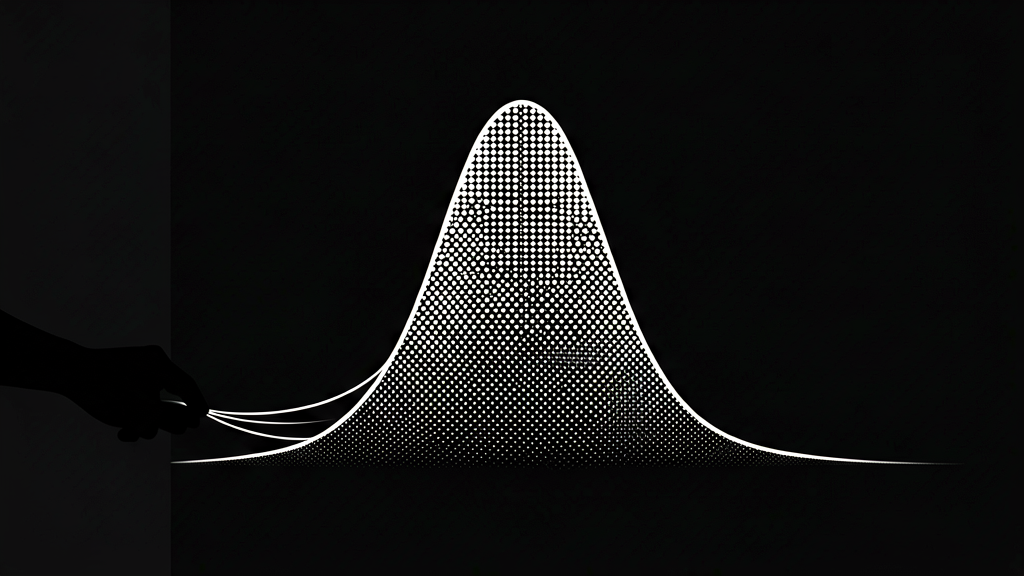
Imagine a bell curve. Along the x-axis, you have every possible design decision, and the y-axis indicates how many people would accept any given decision.
The peak of the curve — the fat middle — is Statistically Significant Taste: what 80% of people would find acceptable, pleasant, correct. It is the convergence of every design school lesson, every UX heuristic, every “best practice” that has hardened into convention.
AI lives here.
When you ask an AI to design a landing page, it produces something clean, well-proportioned, with a three-column layout and the back button placed on the left of the screen. The typography works. The spacing breathes. The hierarchy scans. Nobody would call it ugly, and nobody would call it surprising. It has taste — statistical taste. It has learned from millions of examples which decisions land in the acceptable zone, and it reproduces that zone with mechanical consistency.
This is not a criticism. The middle is profitable, professional, and functional. But it is not where new directions come from. New directions come from the edges.
Judgement Acts On the Curve
Here is the critical distinction: taste lives in the bell curve. Judgement acts on it.
The edges of the curve are where the new exists. By definition, they are the parts that don’t yet have the acceptance that the fat middle enjoys. When punk music arrived in the 1970s, it was at the far tail. By every measure of taste, it was noise. Three chords. Distortion. Vocals that sneered instead of sang.
But someone with judgement heard it and decided: this matters. More people need to hear it. They produced it, positioned it, and over time, punk’s aesthetics bled into the mainstream. The Ramones’ “Blitzkrieg Bop” is now a stadium anthem.
The same pattern plays out everywhere. Hip-hop. Techno. Grunge. Dubstep. Minimalism. Brutalism. Swiss typography. Every form that now fills stadiums or defines conventions was once an edge that someone decided to move toward the middle.
Judgement is the force that moves things along the curve. It is the force that decides what belongs closer to the centre.
AI can generate something in the style of punk. It can even produce something genuinely unusual by accident. But deciding that punk should be pulled toward the centre — that has always been a human decision.
One could object that if AI learns from enough successful transitions — punk to stadium, hip-hop to Billboard, minimalism to Apple Store — it could learn which edges deserve promotion. But judgement is exercised in real time, before success is knowable. It requires living in the present moment, sensing what the centre has grown too comfortable with, and acting before the data confirms you were right. That’s a human quality.
Judgement Is Timed
Banksy’s stencil work is not powerful because of its technical execution. A competent art student could reproduce it. Its power comes from how precisely it captures a specific cultural moment — early-2000s Britain, obsessed with consumerism and surveillance. Remove Banksy from that context and the same spray paint on the same wall is just vandalism. The judgement was in the when, not the technique.
This pattern is universal because culture is always in motion. Warhol held a mirror to 1960s mass production. Björk heard glossy predictability settling over late-90s music and answered with glitch and orchestra. Gehry shattered the glass-and-steel complacency of 1990s architecture. Each was a commentary on the specific norms their era had grown too comfortable with.
The centre shifts with every generation, and so must the act of pushing against it.
Judgement Cascades
If you have seen The Devil Wears Prada, you know the scene. Andy, the assistant, sniggers at a meeting about fashion decisions, as if they’re trivial. Miranda Priestly turns on her:
“You think this has nothing to do with you. You go to your closet and you select… that lumpy blue sweater because you’re trying to tell the world that you take yourself too seriously to care about what you put on your back. But what you don’t know is that that sweater is not just blue. It’s not turquoise. It’s not lapis. It’s actually cerulean.”
She traces the colour from Oscar de la Renta’s collection, through Yves Saint Laurent’s military jackets, through eight other designers, through department stores, all the way down to the clearance bin where Andy found it.
The point is not that fashion matters more than we admit. It is that what Andy thinks is her own casual choice is actually the residue of a judgement made far above her. Someone decided that cerulean, not turquoise, not lapis, was the colour that deserved attention this season. That decision cascaded through an entire supply chain — design houses, manufacturers, distributors, marketers — and reshaped what thousands of people would wear, buy, and see themselves in. Judgement does not stay in the boardroom. It reaches into your closet, your screen, your street. It shapes aspiration, commerce, and identity, often invisibly.
AI can produce cerulean. It learned that blues work, that cerulean appeared in enough training examples to count as acceptable. But deciding that cerulean should be the colour this year — that has always been a human role. And that role is not reserved for fashion editors in Paris. It is the work of anyone who shapes what others will see, use, and inhabit. That brings us to the question most designers are now quietly asking themselves.
Choosing Between Two Equals
For years, taste was enough. A designer’s ability to pair the right typeface with the right grid, to know when whitespace had gone from elegant to empty — that was the moat. But AI is filling that moat with statistical concrete. The reflexive response is to ask: What can I make that AI would not make? That reflex is a trap. Being defined by what you are against is not a strategy — it is a cage. The better question is simpler: Now that the baseline is handled, what world do I want to build?
In the long term, AI will handle the baseline. We will no longer choose between right and wrong — the obvious, the competent, the merely acceptable — because the machine will see both options and produce the safer one before we even ask. The work that remains is harder: choosing between two rights. And that requires judgement — the consistent application of perspective, formed through experience, sharpened by living inside culture, and requiring the willingness to take a position on where the world should go next.
Discussion