
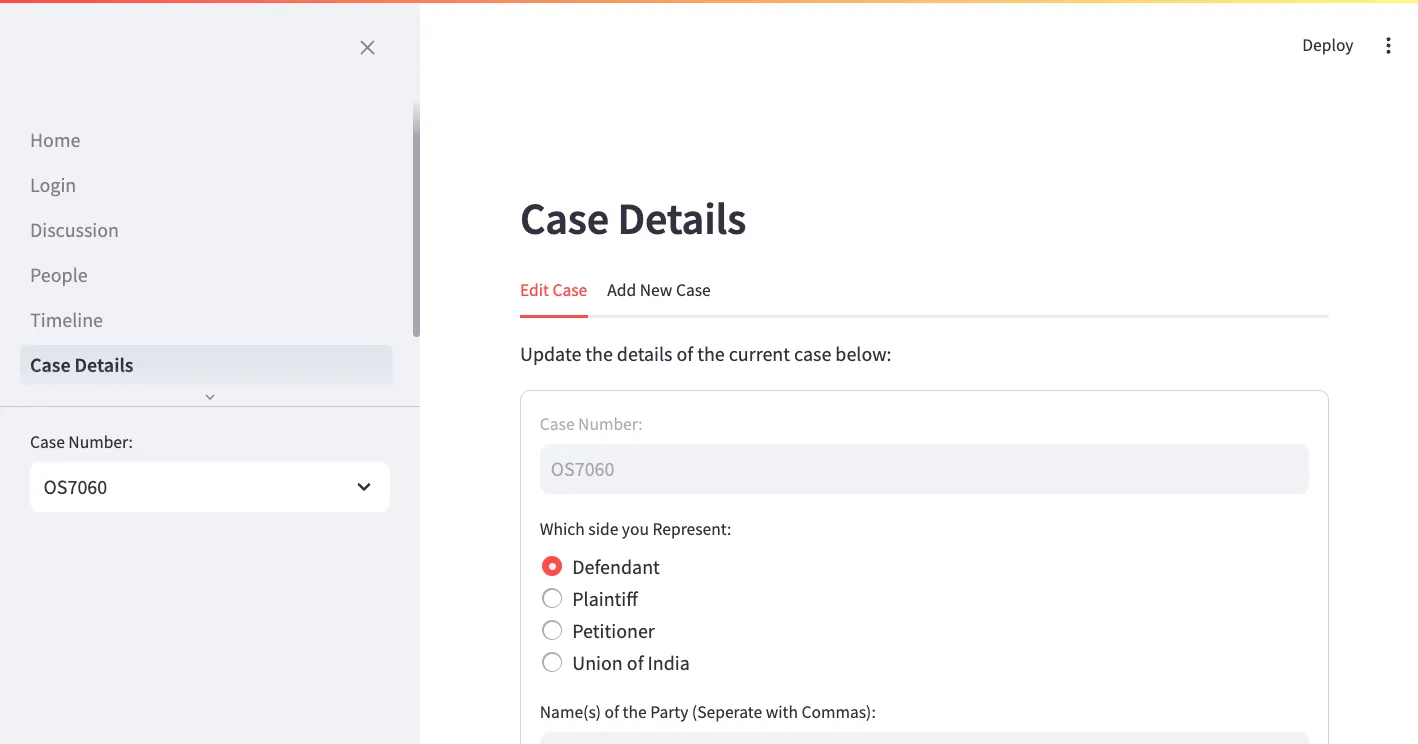
This v. That is a web app to help you keep up with on-going lawsuits. Clients can ask any question about their case without taking up a lawyer’s time, while lawyers get instant access to case details — people, timelines and facts — without wading through thousands of pages. Powered by RAG over case documents with AI-assisted discussion, timeline extraction and actor identification.
What it is. A case workspace built on top of the documents a lawsuit generates. Case files — filings, evidence, correspondence — are ingested, indexed, and made answerable. Clients ask questions in plain language and get answers grounded in their own case documents; lawyers get structured views of the same material without manual file-digging.
The problem it solves. A lawsuit produces thousands of pages, and the people who most need to understand it — the clients paying for it — can’t read it all, and shouldn’t have to call their lawyer for every “wait, who is this person again?” question. Meanwhile lawyers burn hours relocating facts they half-remember. The gap between the case and the people living through it is a time drain on both sides.
How it works. The pipeline runs retrieval-augmented generation (RAG) over the case corpus, so every answer cites the underlying documents rather than inventing plausible-sounding details. Alongside the chat, the system builds structural aids automatically: a case timeline extracted from the filings, and actor identification — who each person in the file is and how they connect — so the case’s cast of characters is navigable instead of overwhelming.
A concrete use case. A client reads a court notice mentioning a name they’ve never heard. Instead of a billable phone call, they ask the app: it identifies the person, explains their role in the case, and cites the filing where they first appear — in under a minute.
Who it’s for. Law practices managing multiple active cases, and their clients, who get transparency without the meter running.
See the code at github.com/sharan01x/casewatch.
