
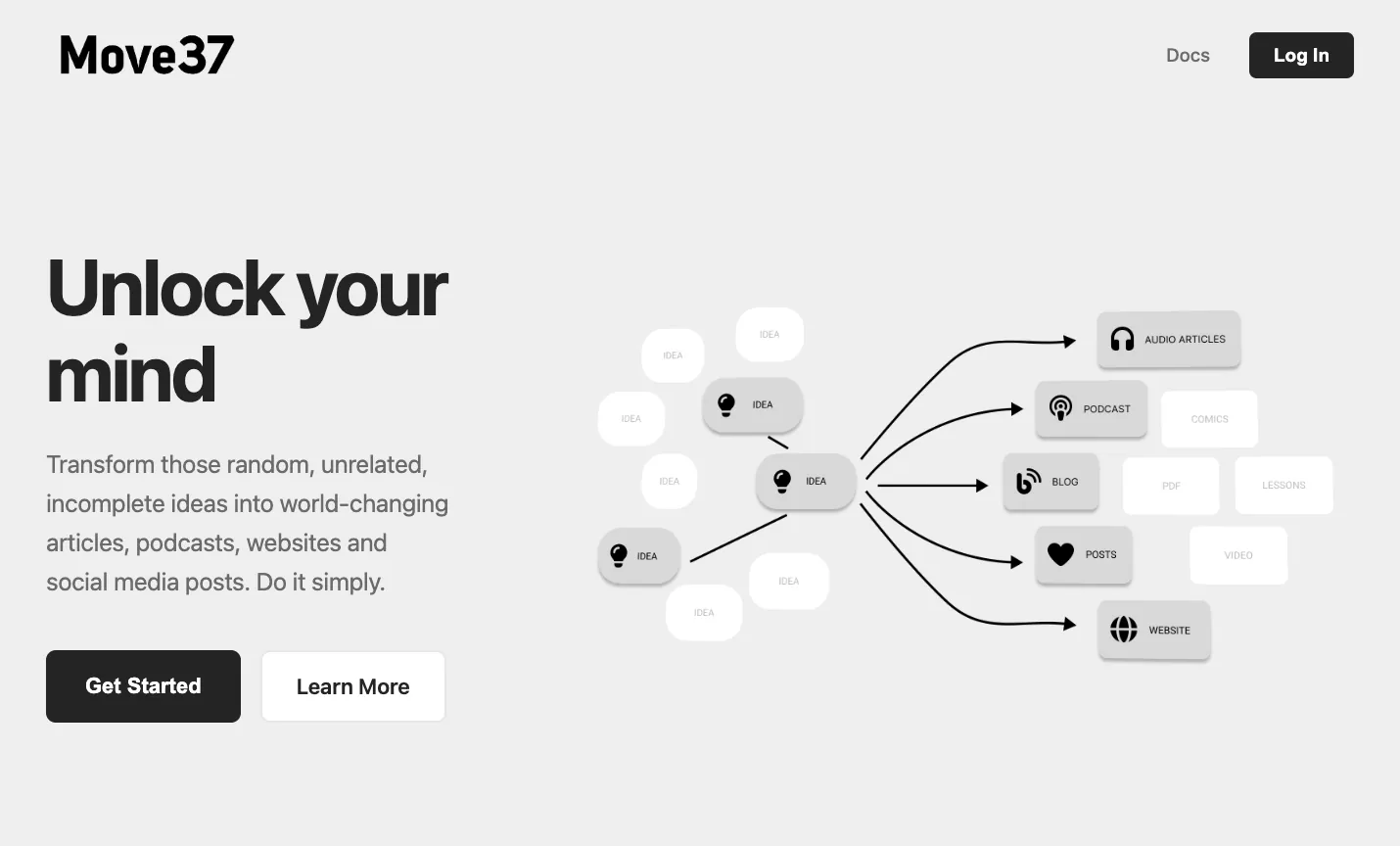
Move 37 is an AI assistant application that helps you record, organise, recall and act upon information you provide it. All run locally — your data stays yours.
What it is. A personal knowledge assistant with a chat-shaped surface. You feed it things — notes, thoughts, documents, half-finished ideas — in whatever order they occur to you, and it organises, connects, and surfaces them when they’re relevant. It’s built around a simple loop: capture without friction, recall without ceremony, act without losing the thread.
The problem it solves. Most note-taking tools fail at the second half: capture is easy, recall is work. A pile of notes is only useful if something surfaces the right one at the right moment, and manual folder-and-tag systems put that burden back on you. Move 37’s organising idea is that recall should be a conversation — you ask in plain language, it answers from what you gave it.
Who it’s for. People whose working lives run on captured information — founders, researchers, writers, consultants — and who are unwilling to trade privacy for the convenience of a cloud assistant. Everything runs locally: storage, search, and the model all live on your machine.
How it’s built. Local-first by architecture, not by policy. Documents and notes are indexed on-device with semantic search, an assistant layer handles organising and connecting what you’ve given it, and actions — reminders, summaries, follow-ups — operate on the local data. Nothing leaves the machine.
A concrete use case. You mention a supplier’s quote in a note three months ago. When a pricing question comes up today, you ask Move 37 in conversation; it finds the note, summarises the relevant figures, and links back to the original — no folder archaeology required.
The name. Named for the move AlphaGo played against Lee Sedol in 2016 — the unexpected move that looked wrong and turned out to be brilliant. A reminder that useful intelligence sometimes looks odd at first.
See the code at github.com/sharan01x/move37.
